Apple Quietly Rebuilds HomeKit Secure Video for the Next Generation of Smart Cameras
When Apple announced that HomeKit Secure Video would finally support 4K in iOS 27, it sounded like a straightforward upgrade. However, after reading through Apple’s newly published HomeKit Secure Video Compatibility Guide, I don’t think 4K is the biggest story. Instead, it looks like Apple has quietly redesigned almost every part of HomeKit Secure Video, introducing what feels like a completely new camera architecture for the next generation of smart cameras.
4K Is Just One Piece of the Puzzle
Native 4K recording is finally coming to HomeKit Secure Video, removing one of the platform’s biggest limitations. The new specification also introduces native 2K support, higher HEVC bitrates and a new “Highest” video tier, allowing compatible cameras to provide both 4K and 2K streams simultaneously. Those improvements alone are significant, but they’re only a small part of what Apple has changed.
Apple lists target bitrates of up to 5 Mbps for 4K, 3 Mbps for 2K and 1.8 Mbps for 1080p. That is important because better image quality is not just about resolution. Higher bitrates and HEVC support should help preserve more detail, especially in busy scenes with movement, low light or complex backgrounds.
A Completely New Camera Architecture
Reading through the specification, one thing quickly becomes obvious: this isn’t simply a document explaining how cameras should record in 4K. Apple has introduced an entirely new collection of services covering everything from camera capabilities and streaming to recording, security and buffer management.
The new or updated services include
- Camera Capabilities
- Camera Buffer Management
- Camera Recording Management
- Camera Key Management
- Camera Client Certificate Management
- WebRTC Streaming
- Multi-Tier RTP Streaming
Collectively, these represent one of the biggest architectural changes HomeKit Secure Video has seen since it launched.
Cameras Are Becoming Much Smarter
Perhaps the most interesting shift is how much more Apple now expects cameras to understand about themselves. Rather than simply exposing a video stream and motion events, cameras can now advertise detailed capabilities, multiple image sensors and different video stream tiers.
Apple has also introduced explicit multi-sensor support, allowing cameras to report multiple sensor configurations and identify which sensor contributed to a motion event. The specification even defines sensor intents such as Main and Package, suggesting Apple is preparing HomeKit Secure Video for increasingly advanced camera hardware. While the document doesn’t explain how these sensors will appear inside the Home app, it clearly shows that Apple is no longer designing HomeKit Secure Video around the assumption that every camera has a single image sensor.
Modern Streaming
Another significant addition is WebRTC alongside traditional RTP streaming. Compatible cameras are now expected to support multiple simultaneous WebRTC and RTP sessions, allowing several Apple devices to access live video at the same time. Although Apple doesn’t explain why it made this change, WebRTC has become the standard for low-latency, real-time communication and should provide a much more modern foundation for future Apple Home devices.
A New Recording Pipeline
Apple has also introduced an entirely new recording architecture. Dedicated services now exist for camera buffers, recording uploads and event queues, providing a much more sophisticated recording workflow than previous HomeKit Secure Video implementations.
The company doesn’t claim these changes will improve reliability, but they should give manufacturers far greater control over how recordings are handled. Whether that ultimately reduces missed recording events remains to be seen, but the foundations are certainly more advanced than before.
Why Apple Said “Supported Cameras”
Looking back at WWDC, one detail now stands out. Apple didn’t simply announce that HomeKit Secure Video was getting 4K. Instead, it said the feature would be available on “supported cameras.”
After reading the specification, that wording feels much more deliberate. Supporting 4K isn’t simply about enabling a higher recording resolution. Manufacturers will need to implement Apple’s updated HomeKit Secure Video architecture, including the new streaming, recording and camera capability services.
That doesn’t necessarily mean existing cameras can’t be updated, but given the scale of the changes, I suspect many manufacturers will reserve the full experience for future hardware rather than retrofitting every existing product. It’s also likely that some lower-cost cameras simply won’t have the hardware required to support everything in the new specification. Native 4K recording, multiple simultaneous video streams, WebRTC and the redesigned recording architecture all place greater demands on a camera’s processor, memory and image processing pipeline.
What is clear though, its not just enabling a toggle, its means the manufactures will need to implement this new spec completely. But the good news is that if cameras cant support the old architecture, then Apple is still allow the older HomeKit Secure Video spec and older cameras will still run.
That could be another reason Apple chose the phrase “supported cameras” at WWDC—because compatibility may depend just as much on the hardware inside the camera as it does on the software running on it.
What Could This Mean for Apple’s Rumoured Camera?
One thing became increasingly clear as I worked through the document: Apple doesn’t appear to be building a platform for today’s cameras. It appears to be building a platform for the next generation.
That naturally raises questions about Apple’s widely rumoured smart home camera. While this specification doesn’t prove those rumours are true, it certainly provides the kind of modern camera framework you would expect Apple to build before launching its own hardware.
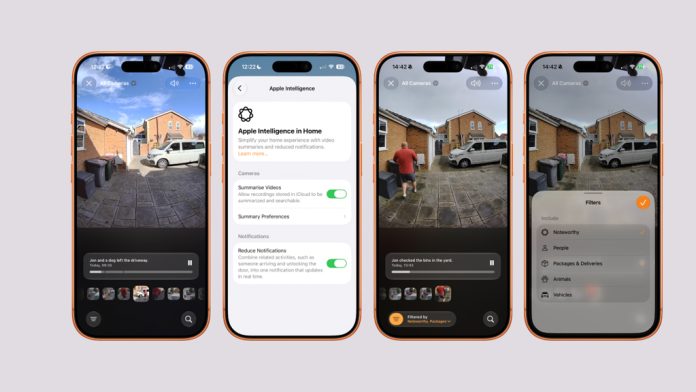
The timing is also interesting. The new architecture aligns well with the Apple Intelligence camera features announced in iOS 27, including natural language search, intelligent notifications and richer event descriptions. If Apple does release its own camera, it would almost certainly be designed to take full advantage of these capabilities from day one.
Final Thoughts
It’s easy to look at this specification and focus on one headline: 4K is finally coming to HomeKit Secure Video. After reading all 37 pages, I actually think that’s the least interesting part.
The real story is that Apple has quietly modernised the entire HomeKit Secure Video platform. Between native 4K support, WebRTC, a redesigned recording pipeline, richer camera capabilities and support for more advanced hardware, this feels less like a feature update and more like the foundation for the next generation of Apple Home cameras.
If that’s the direction Apple is taking, the future of HomeKit Secure Video looks far more exciting than simply recording in a higher resolution.