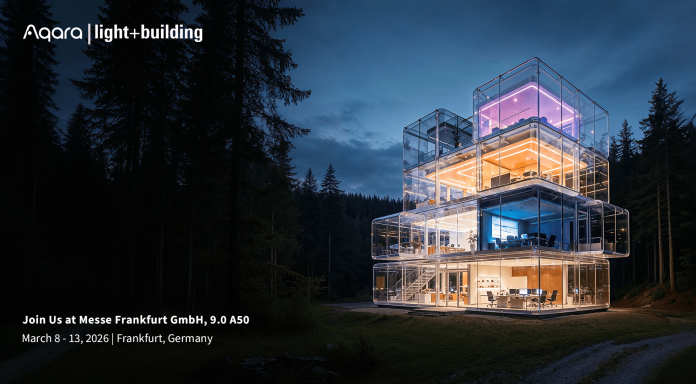
Aqara has quietly introduced a number of new smart home products at Light + Building 2026, the major international trade fair for lighting and building technology held in Frankfurt last week. The company used the event to showcase its expanding ecosystem of connected devices, including new lighting products and two upcoming smart locks designed for global markets.
While much of the announcement focused on professional building infrastructure and automation platforms, the consumer-focused updates are particularly interesting for smart home users. Aqara revealed a new lighting lineup alongside two new locks, the U500 series and the U600, which aim to expand the company’s presence in the smart security category.
Aqara Expands Its Smart Lighting Range
Aqara’s updated lighting lineup includes a range of indoor and outdoor products designed to integrate with modern smart home ecosystems. Among the new devices are outdoor permanent lights, outdoor string lights, a new floor lamp, the LED Strip T2, and the LED Bulb T2 E14. 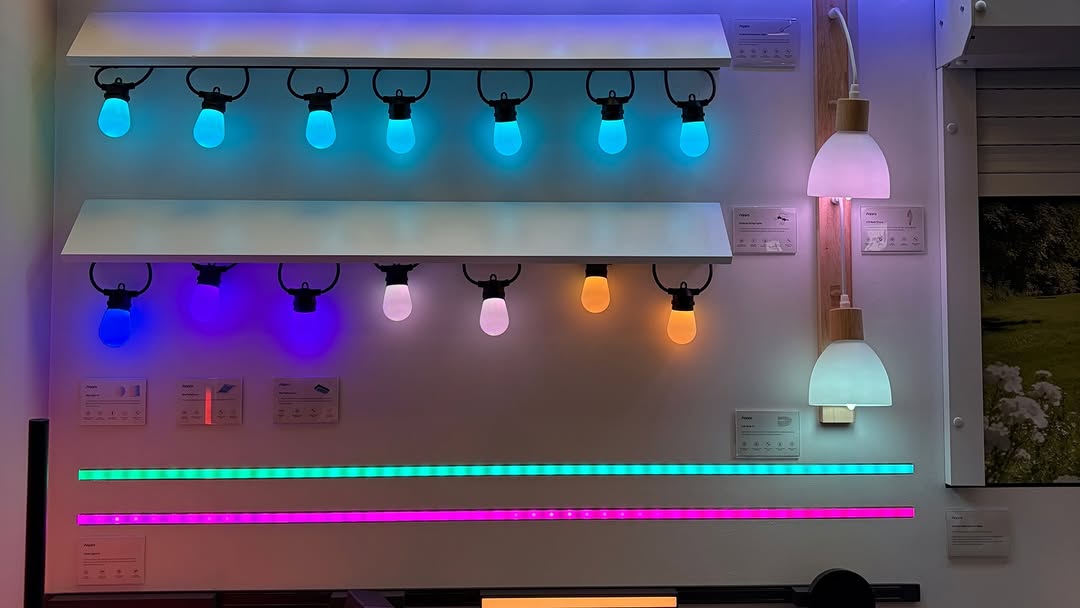
Compatibility is another major focus. Aqara says the lighting lineup will include native Matter support, working across both Thread and Zigbee networks to integrate with major smart home platforms. This approach is intended to allow the lights to work seamlessly with systems such as Apple Home, Google Home, and other Matter compatible ecosystems.
Like other Aqara products, the lighting devices are designed to integrate with sensors, wireless switches, and automation rules. This allows users to create more advanced behaviours such as lights adjusting automatically based on occupancy, time of day, or ambient conditions.
Aqara Smart Lock U500 Series

Alongside lighting, Aqara introduced the Smart Lock U500 series, which expands the company’s lock lineup with several variants designed for different door types.
The U500 series will be available in three versions
• Gate Lock
• Rim Lock
• Glass Door Lock
These variants are designed to work across a wide range of door materials including metal, wood, iron, and glass, allowing installation in situations where traditional smart locks might not be suitable.
A key design goal for the U500 series is flexibility. Aqara says the locks can be installed without requiring modifications to the door itself, making them suitable for both residential and commercial installations where retrofitting a lock is preferable to replacing existing hardware.
Aqara confirmed the U500 should be available in Q2 of 2026
Aqara Smart Lock U600
The second lock announced is the Aqara Smart Lock U600, which appears to be specifically targeted at the UK market. By the looks of the lock it looks like it its a full lock furniture install and will support the lift and lock found on most UPVC and composite doors in the UK
The U600 features a slim, minimalist design and is built around modern smart home standards. Notably, it supports Apple Home Key, allowing users to unlock their door directly using an iPhone or Apple Watch.
The lock also runs on Matter over Thread, which should provide faster response times and improved reliability,. This also enables the device to integrate with multiple smart home ecosystems through the Matter standard.
With Apple Home Key support combined with Matter compatibility, the U600 appears designed to appeal strongly to Apple focused smart home users, particularly in the UK where this type of lock design is common.
Aqara Continues to Expand Its Smart Home Ecosystem
Although Aqara’s presence at Light + Building 2026 largely centred around professional infrastructure and unified management platforms, the lighting and smart lock announcements highlight the company’s continued push into consumer smart home hardware.
The new lighting products expand Aqara’s ecosystem into more flexible lighting scenarios, while the U500 and U600 locks show a clear focus on multi platform compatibility and regional design needs.
As Matter adoption continues to grow across the industry, these devices signal Aqara’s intention to build a broader smart home lineup that works across platforms while still offering deeper integrations for ecosystems like Apple Home.